Friday, July 30, 2010

BP Oil Spill in the Gulf of Mexico

As you all probably know, there has been a huge oil spill in the Gulf of Mexico, which started by the drilling rig explosion on April 20th. The spill has been temporarily stopped since July 15th by capping the gushing oil wellhead.

What is really irritating about the spill is how the situation was handled and how the environment was so severely damaged due to corporate and financial arrogance.

Firstly, it is interesting to note how it all began. There are regulations that are designed to prevent this disasters. When oil-drilling companies like BP operate in other countries, they are obligated to have safety switches that shut off the wells. However, during the Bush administration BP was allowed to operate without these expensive safety measures. Mike Papantonio, an environment lawyer explains the situation:

I would recommend you to also take a look at these extensive articles by the New York Times and Newsweek:

http://www.nytimes.com/2010/06/21/us/21blowout.html?_r=1&hp=&pagewanted=all

http://www.newsweek.com/2010/05/29/black-water-rising.html

It is also stated in the articles that BP workers reported bits of rubber gurgling up through the pipe but their supervisors did not do anything about the situation.

But the more frustrating part is how BP is dealing wit the situation after the explosion. While the environment and the wildlife is being absolutely devastated by the oil, the BP is just stirring and mixing the oil in the water.

They have come up with these so-called containment booms to prevent the oil from going to the beaches. The booms are only 13 inches in diameter and the oil goes right underneath them. This is just ridiculous. Watch the following video showing how the oil spill is being dealt with and how the ecosystem is being completely destroyed.

In addition to such stupid pretending to clean the oil, BP is fighting scientists to keep its publicity. To me, this corruption is incredibly frustrating. BP has started buying scientists from different universities. Their lawyers offer scientists a $250/hour pay to the scientists in exchange for working for the company and keeping all their findings from being published. The following BBC report explores the situation:

http://www.bbc.co.uk/news/world-us-canada-10731408

In addition, the corruption in laws and regulations and their implementation is evident in the case of the substances that BP is throwing into the water. In order to hide their mess, BP is adding dispersants into the spill. These are materials that dissolve oil in water. Therefore, not only the dispersants carry the oil all the way to the bottom of the ocean, affecting almost all organisms along the way, but it makes the oil 19,000 times more poisonous! The dispersants carry the oil right into the body of the organisms and it also dissolves the lipids of the cells of their bodies. As if that weren’t enough, BP refuses to realise information on what chemicals they are using! Scientists are helpless and irritated because they do not even know what to expect if they don’t know what BP is doing. This is really disturbing and it speaks of the corruption of the system. BP realise information on some of these ingredients on June 8th and it turns out that they are using the most poisonous and harmful dispersant because it is the cheapest. I highly recommend watching Susan Shaw’s talk on TED about this issue:

As Carl Safina said in this talk, this is all because “for the last at least 30 years, there has been a culture of deregulation that is caused directly by the people who we need to be protected from,buying the government out from under us.” It is evident that something has to be done about this corrupt corporate culture. I do not believe that capitalism and the corporate system have to be gotten rid of altogether. After all, nothing matches the growth and development and the convenience of a free economic system. It is due to this corporate culture that today we drive such safe and technology-advanced cars instead of Ford’s Model-T. What we do need is some serious regulations and their fair implementation. Ultimately, the integrity of the government lies upon the people. After all, as it has repeatedly been shown in history, no one is as strong as the people. And this is getting easier as advances in technology are making the world more and more interconnected and transparent.

I am going to finish off by a poetic quotation that I recently read, in response to how we are ignorantly ruining our environment and ultimately hurting ourselves:

"Only after the last tree has been cut down,
only after the last river has been poisoned,
only after the last fish has been caught,
only then will you realize that money cannot be eaten."

Tuesday, July 27, 2010

Headset that Reads Brainwaves

I haven’t posted anything in a long time, as I have been busy with other things. But I came upon new piece of technology that is just too cool to ignore.

Emotive Systems has created a headset that uses the user’s brainwaves as the interface of the computer. Thus the user can do whatever he or she wants by simply thinking about it.

This is not a completely new technology in its hardware and it is actually not very profound in scientific terms. By that I mean the device does not really know the functioning or the anatomy of the brain. It is simply an algorithm that records brainwaves when the user thinks of doing a certain task and then the computer performs that task whenever it is provided with the same input. This means that the technology is limited since the computer has to first match each of the specific tasks that it offers with a certain brainwave. However, I must add that the algorithm is not as simple as it sounds since it has to detect, filter, and recognize brainwaves. Obviously, brainwaves are much more complicated, variable and noisy than a simple digital circuit.

Nevertheless, this technology is profound in human-computer interfacing and indeed very enjoyable to use.

I think we have just seen the future of human-computer interfacing. Click on the video and watch for yourself:

This summer I am reading the Feynman Lectures on Physics written by Richard Feynman and The Selfish Gene written by Richard Dawkins. I will probably write a review on them some time before university starts.

Friday, May 21, 2010

The First Synthetic Cell

Yesterday, the creation of the first synthetic cell was announced by Craig Venter, one of the greatest biologists of our era. This is the first self-replicating organism on the planet whose parent is a computer.
After a fifteen year journey (during which he also decoded the human genome), Craig Venter's team successfully made a complete synthetic genome, transplanted it to a bacterial cell, and booted it up in the cell to produce a new species. The genome was designed on computers and created from four bottles of chemicals. Then, the chromosomes were assembled in yeast. One of the major obstacles was to boot up the genome in the bacterial cell, since the transplant chromosomes were rejected and destroyed by the recipient cells. Advances were made to remove restriction enzymes from recipient cells and insert chromosomes with methylated DNA in the cells.
Other problems in the project were debugging issues. Initially, the transplanted chromosomes did not support life because only one base pair was deleted. This led to the development of debugging programs that made the production of the life-supporting synthetic genome possible.

One interesting aspect of this genome is that it has watermarks embedded in it for identification. Using a specific code, the names of the authors and the website of the genome were spelled out in the genome.

This amazing breakthrough has vast implications. Firstly, it tells us about the basic recipes of life as well as the dynamic nature of it. It also provides technical advancements such as the production of vaccines and production of new and useful species, such as algae that can make oil out of the carbon dioxide in the atmosphere. We can only begin to imagine what might come out of this astonishing revolution.

Saturday, May 15, 2010

Irrationality Proofs

Number theory has always been a fascinating topic to me. If one stops and thinks, the concept of irrational numbers is a very intriguing one; numbers that we cannot determine the exact value of. For example we cannot locate the exact value of √2 on the number line. I find this idea very strange and curious.

To be more precise, irrational numbers are those that cannot be expressed as the ratio of two integer numbers. One interesting approach is to examine irrational numbers by continued fractions. Every number can be written as a continued fraction in the form of


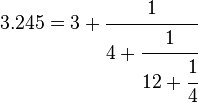
This is an alternative to decimal representations, which is not based on a specific base number. For example:

Irrational numbers are in fact produced from infinite continued fractions. For example:

The value of a number can be approximated to different accuracies by truncating the continued fraction at different poinst.

Determining the continued fraction for an irrational number is also very interesting and I might cover it in a later post. In this post, I am going to prove the irrationality of some numbers such as √2 and π.

Irrationality of √2:

This is proof by contradiction. Let’s assume there is a simplified fraction a/b which is equal to √2.

a/b=√2

a=b√2

a^2=2b^2

∴a^2 | 2

∴a|2 since a∈Z

Since a is even, b cannot be even (since a/b is a simplified fraction).

Since a is even, there should be an integer k for which a=2k.

(2k)^2=2b^2

4k^2=2b^2

b^2=2k^2

∴b^2 |2

∴b|2 since b ∈Z

But b cannot be even. Since a and b are both even, a/b is not a simplified fraction. Therefore, by proof by contradiction, √2 is irrational. Specifically, this is called proof by infinite descent.

Irrationality of π:

This proof is much more difficult and interesting. We are again going to use proof by contradiction. Since this proof involves a lot of exponents, derivatives, and integrals, I have written the proof in Microsoft Word and I am going to upload it here as images.

In future posts I might show irrationality proofs of other numbers as well as proof of transcendence, which is another interesting property of some numbers.

Monday, May 10, 2010

Computing a Theory of Everything

Stephen Wolfram has initiated an interesting approach in studying the physical universe. He tries to create our physical universe out of the much more diverse computation universe, the vast abstract universe of computation and mathematics.

Wolfram has created Mathematica and Wolfram|Alpha, two very powerful mathematical/computational tools. He is also the author of "A New Kind of Science" (which is available online). Wolfram has established a new kind of science (as he calls it) which examines the complexity of systems from very simple computational rules.

In his talk at TED, he outlines this idea and how it relates to our physical world, in the sense that our seemingly complex universe could be the product of simple rules which could be simulated in computers. Wolfram has done much research on this issue and has actually created universes that come very close to ours.

I personally believe that this approach is very valuable and successful. Our understanding of nature lies in understanding complexity in systems consisting of different parameters. Not only will this approach make contributions to theoretical physics (hopefully), but it will also allow us to understand much more complex systems such as those in biological organisms. Something as complex as the brain can only be studied from this approach.
As a matter of fact, a very interesting field named Computational Neuroscience is being established. Many mathematicians, programmers, neuroscientists, and physicists will come together to study the brain from a computational point of view. I personally cannot wait to see what will come out of this in the upcoming years.

Neil Turok's TED Prize Wish

Neil Turok is the director of the Perimeter Institute for Theoretical Physics and a very successful physicist. I was rather shocked when I came upon his Prize Wish video at TED. Alongside his successful academic life, he manages to be quite active in helping other people and providing aid and education in Africa. I think this is an interesting and moving talk by him that really shows some important values:
http://www.ted.com/talks/neil_turok_makes_his_ted_prize_wish.html

Sunday, May 9, 2010

Some Interesting Quotes

Here is a list of some interesting quotes that I have encountered here and there. I tried to put them in order from my most favourite to least, but it's not that easy. Here is what I came up with:

"It is not complicated; there is just a lot of it."
Richard P. Feynman

"Life is a sexually transmitted disease."
R. D. Laing

"Physics is like sex. Sure, it may give some practical results, but that's not why we do it."
Richard P. Feynman

"Genius is one percent inspiration, ninety nine percent perspiration."
Thomas A. Edison

"In science one tries to tell people, in such a way as to be understood by everyone, something that no one ever knew before. But in poetry, it's the exact opposite."
Paul Dirac (1902 - 1984)

"We must not forget that when radium was discovered no one knew that it would prove useful in hospitals. The work was one of pure science. And this is a proof that scientific work must not be considered from the point of view of the direct usefulness of it. It must be done for itself, for the beauty of science, and then there is always the chance that a scientific discovery may become like the radium a benefit for humanity."
Marie Curie (1867 - 1934), Lecture at Vassar College, May 14, 1921

"It is our choices that show what we truly are, far more than our abilities."
J.K.Rowling